Creating Strong Video Game Characters
 MikyWay
L’essentiel 🎯
| Ref | Description | Duration |
|---|---|---|
| Creating strong video game characters | Conference on character creation and how to make them interesting. | 52 minutes |
Jeremy Bernstein presents a model for understanding what makes a character and how to use it to create a character with depth that will touch the player.
- Set in an emotional context
- Helps the player connect to the story
- What you remember most
- Very much tied to the story
Someone wants something but struggle to get it.
(Definition of the basic element of a story and a character.)
The actions that the character will do to get what he wants are what define him.
💠 For example, a villain will not hesitate to perform immoral actions.
The actions of the character in a video game are translated by the gameplay.
⚠️ It’s important that the gameplay matches the character.
The author invokes a model composed of 3 units :
- 🎯 Goal unit What the character wants
- 🤸♂️ Unit of actions The actions they perform to get what they want.
- 👺 Appearance unit How does it show itself?
Video game character 👯♀️ 👯♂️
- An avatar is simply a set of pixels manipulated by the player (e.g. a brick in tetris, pacman, early zelda, mario, etc.).
It acts at the level of mechanics.
- A character is deeply rooted in the story, with a purpose and an emotional context.
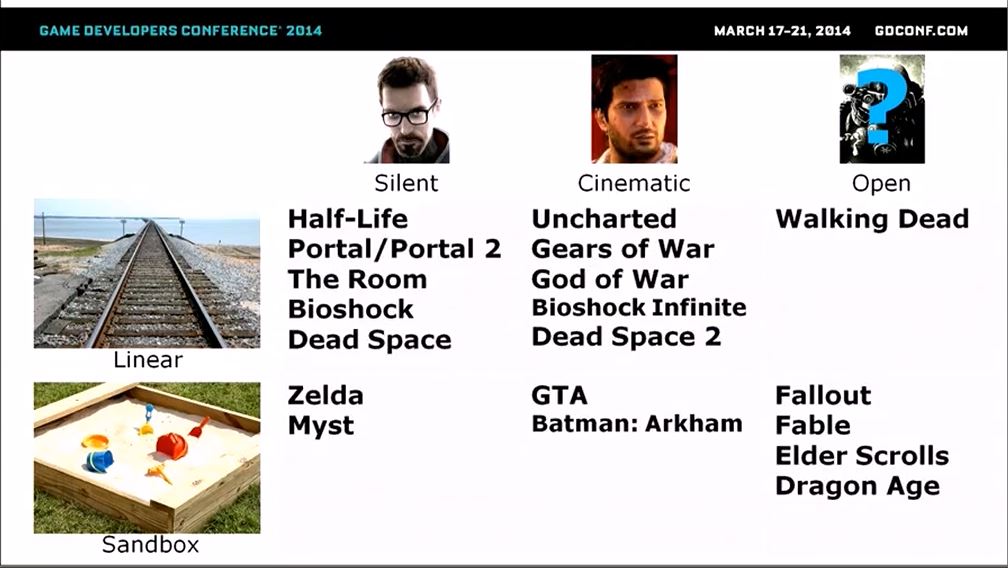
The 3 main types of characters in video games are :
- The non-speaking character
- The cinematic character
- The open character
The model 📋
The model presented by Jeremy Bernstein is composed of 3 questions about the character:
- What does the character want?
- What does he do to get what he wants?
- How does he show himself?
From these 3 questions he evokes 3 units:
- 🎯 Unit of purpose
- 🤸♂️ Unit of actions
- 👺 Appearance unit
1️⃣According to the author, 🎯 the goal unit is the most important. This is because if there is a ❌ dissociation between 🎯 the player’s unit of purpose and the character’s unit of purpose, the game experience falls apart.
💠 For instance, if the character doesn’t want to talk to anyone, and we keep talking to NPCs.
2️⃣The second most important unit (🤸♂️ of actions) is the 🤸♂️ unit of actions. It’s less damaging in the event of dissociation, and can work even if it’s only aligned with the character.
💠 For example, when you play a Batman game, you’re not surprised to do things that none of us would do.
3️⃣The last unit (👺 appearance), according to the author, is not a problem if the player and character are not aligned.
Conclusion 📝
The conference is a useful tool for understanding character creation, and through its model offers tools to feed this reflection work, which must take place upstream of development.