Cursed Problems in Game Design
 MikyWay
Key takeaway 🎯
| Ref | Description | Duration |
|---|---|---|
| Cursed problems in game design | Talk about certain game design patterns that can lead to a dead end for the game designer. | 52 minutes |
cursed problems. Instead of fighting this dead-end problem, he advises us to recognize it as soon as possible, and suggests 4 solutions, not to eliminate the problem, but to work around it.cursed problem is a game design problem with no solution, resulting from a mismatch between the expectations of the player(s) and the game. For example, a loot game with an efficient exchange system. The loot experience will inevitably be diminished by the fact that items can be purchased at auction houses.- Barrier
- Draw a line between the two conflicting elements.
- Gate
- Allow interaction between the two elements, but make it difficult for the player.
- Carrots
- Encourage the player to move towards the desired element using a variety of baits.
- S’mores (i.e biscuit)
- Accept and integrate the disruptive element.
Identify a cursed problem 🔎
Sometime finding the solution isn’t the right thing to do.
To avoid spending an inordinate amount of time on a problem without a solution, it’s important to recognize a “cursed problem” early on. But you need to know what a cursed problem is.
Definition of a cursed problem 📜
According to Alex Jaffe, a cursed problem is a game design problem with no solution. It can arise from different player motivations that don’t mesh, or from a problem between incompatible game objectives.
To further define this concept, the author evokes another element he calls the “player promise”, which corresponds to the essential experience of a game (i.e. why the player comes to play). A cursed problem would therefore be a game with several mutually incompatible player promises.
Examples
1️⃣ The first example given by Alex Jaffe is the idea of a Beat’em up multiplayer. There will be an incompatibility between players who want to improve in combat (i.e.
player promise 1) and those who only want to win (i.e.player promise 2). Quite simply, the best player in the fight won’t necessarily be the one to win. In a multiplayer game, players will quickly realize who is the strongest in combat, and find alternatives to win. Winning is more a matter of politics, through alliances and betrayal.
two: The second example given is that of a loot game with an efficient exchange system. The two concepts are incompatible.
✨ Quiz ✨
⚠️ Rules ⚠️
💠 You have to guess if the situation is a cursed problem or just an hard game to make. 💠
- 1️⃣ A turn based cooperative games.
Cursed problem because some player want a cooperative experience, other only win and are ready to centralized the decision making.- 2️⃣ Exploration games with millions of worlds
Hard because there is no incompatibility.- 3️⃣ Always-on-location-based-games
Cursed problem because there is incompatibility.Resolve a Cursed problem 🔓
Barrier
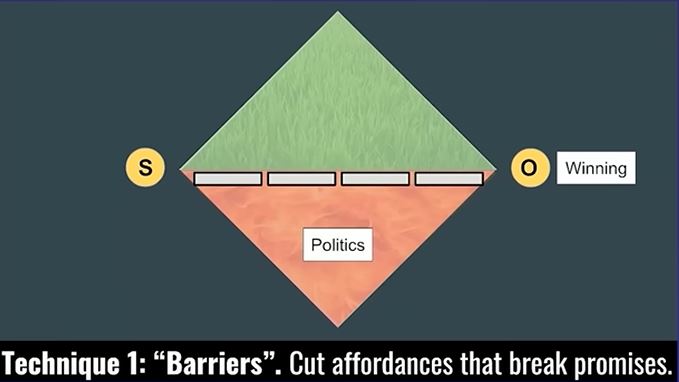
The barrier design technique consists of separating the 2 incompatible player promises and keeping the player on the side you want.
🔸 If we take the example of the loot game with exchange, it could be to limit the type of items to be put on the HDV, for example legendary items could not be obtained via the auction house.
Gate
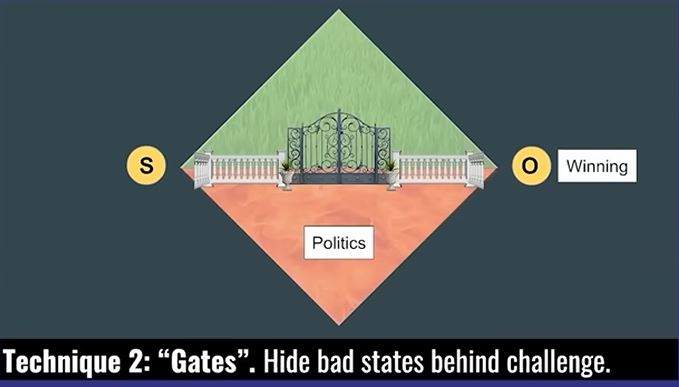
The idea of the door is to allow the player to go to the side he wants (e.g. play politics in a fighting game) but make it very difficult.
🔸 Reducing the visibility of scores is a good example. Players won’t be able to easily tell who the current winner is, which will put the brakes on political attempts to win 😉.
Carrots
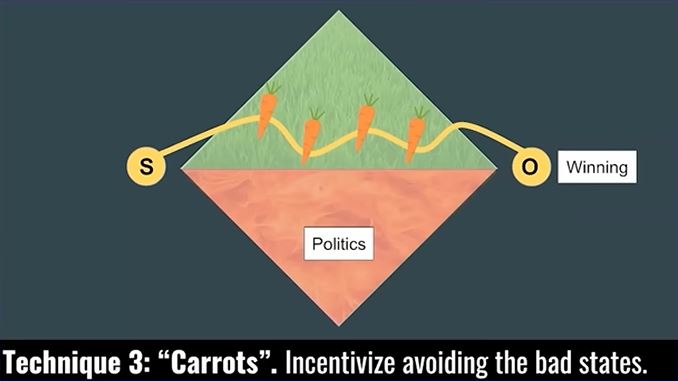
Instead of blocking or preventing the player, the idea here is to encourage him to stay where you want him to.
🔸 Recording and broadcasting all combat-related actions at the end of the game, and offering positive feedback for every successful strike, is a way of encouraging the player to take part in the fight rather than trying politics.
S’Mores
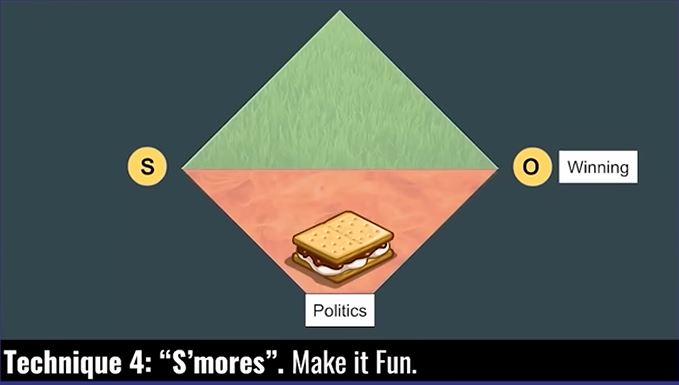
Finally, the last technique is simply to accept the two elements (i.e. player promise) and make them fun.
🔸 In the case of a multiplayer Beat’em up, this would translate into mechanics that allow for more politics. For example, the ability to form temporary teams.
Conclusion 📝
⚠️ These techniques and concepts should not be taken as something fixed and rigid. The cursed problem suffers from a non-consensual and undefined definition. As a result, a game can be seen by some as cursed and by others not.
🔷 Nevertheless, the concept has the merit of awakening us to potential design problems which, if not identified early on, can become very problematic.
🔹 What’s more, the author offers potential design solutions that are worth knowing about.